I’m testing Ahrefs’ AI Humanizer tool for SEO content and I’m not sure if it actually improves rankings or just rephrases text. Some posts passed AI detectors, others didn’t, and I’m worried about long‑term risk with Google. Could anyone share real‑world results, pros and cons, or better alternatives for safely optimizing AI‑assisted content?
Ahrefs AI Humanizer
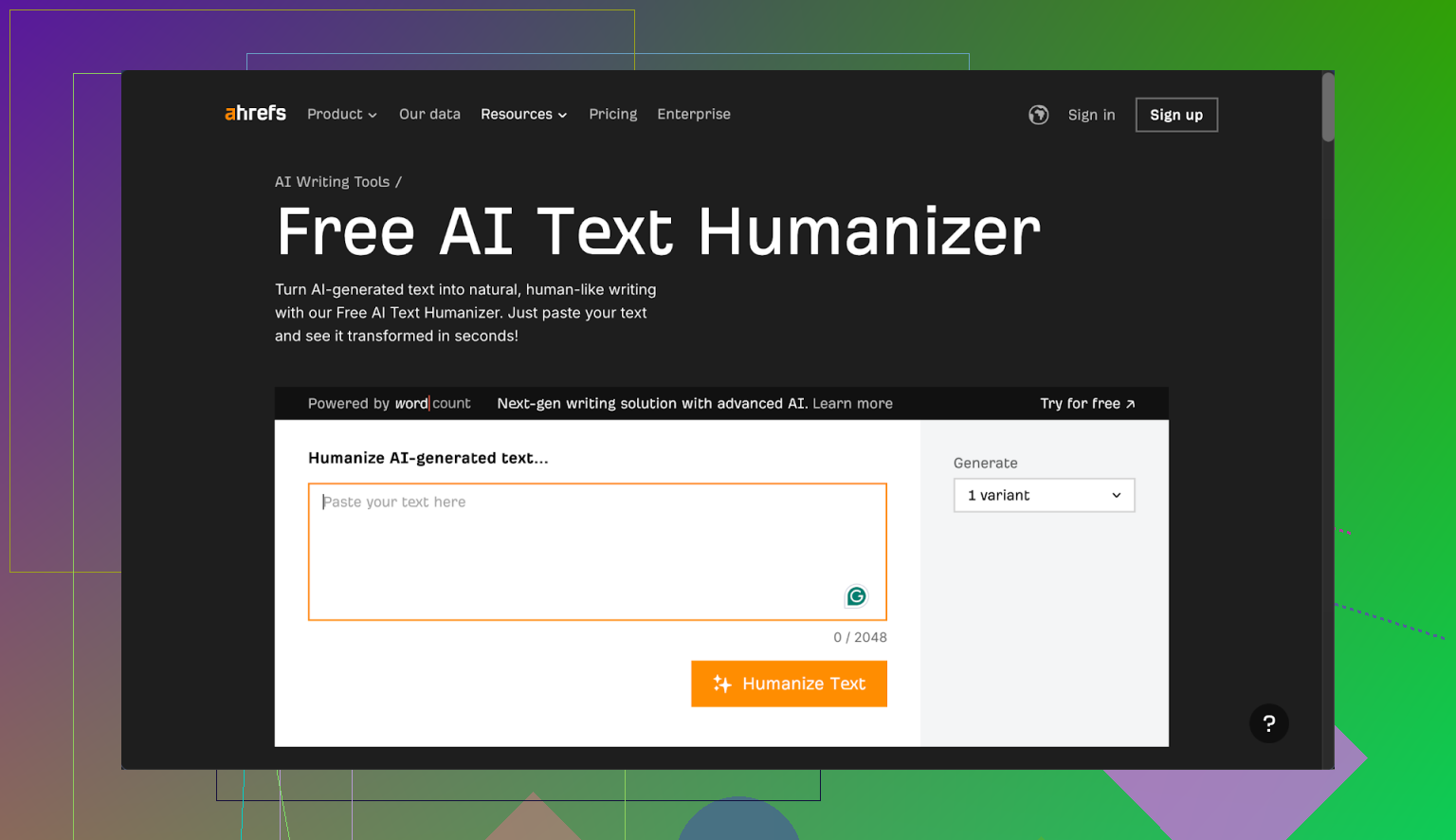
I spent some time playing with the Ahrefs AI Humanizer and the short version is: it looks solid on the surface, then falls apart where it matters.
If you want the background, Ahrefs is big in SEO. I went in expecting something decent here:
What actually happened was kind of odd.
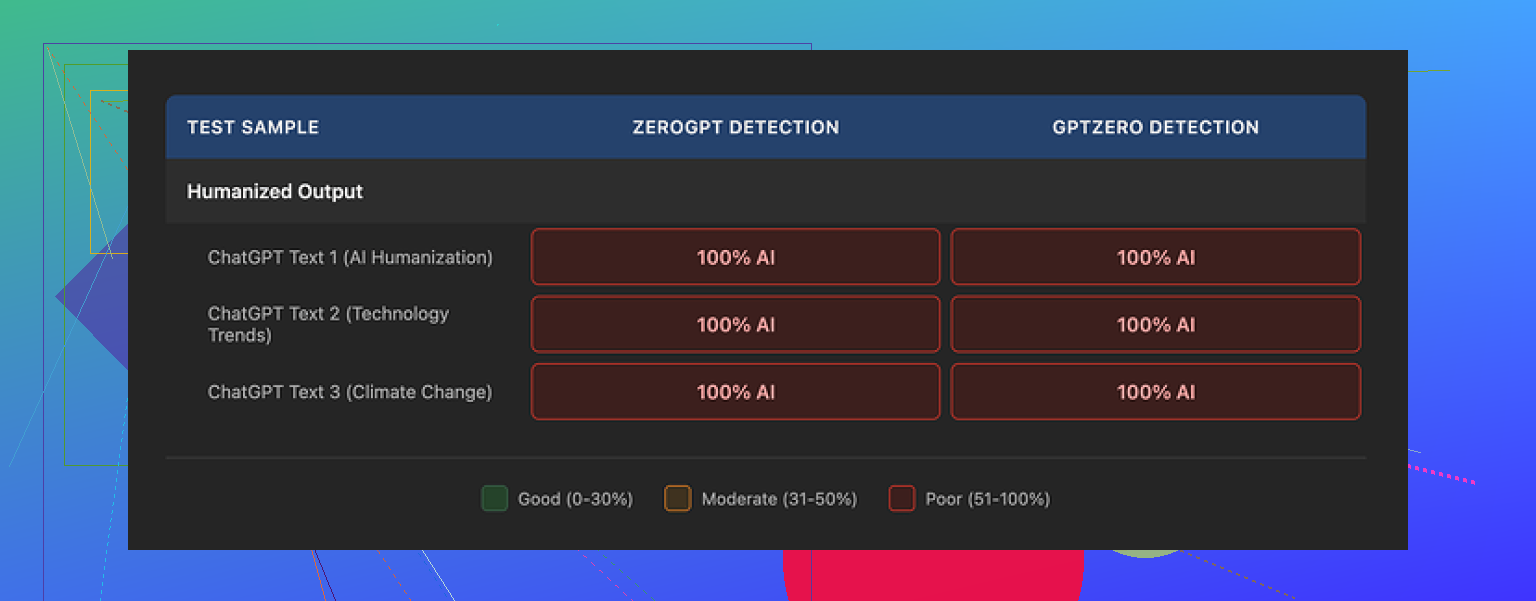
I took a few AI-written samples and ran them through the Ahrefs humanizer. Then I tested the outputs on GPTZero and ZeroGPT. Every single one came back as 100% AI. No wobble, no partial score, straight AI.
The strange bit is their own interface. Above the humanized text, it shows a detection score. That score also said 100% AI on its own output.
So you get this situation where:
- You paste AI text.
- Ahrefs returns “humanized” text.
- Ahrefs’ own detector tells you the result is still fully AI.
Here is how the interface looks:
From a writing standpoint, the results were not awful. If I had to rate the readability and grammar, I would put it around 7 out of 10. No obvious grammar glitches, flows okay.
Then you start noticing the tells.
It leaves long dashes exactly as they were. It keeps those predictable AI intro lines, like “One of the most pressing global issues” and similar stuff you have seen hundreds of times from generic LLM outputs. So if you have an eye for AI text, nothing feels “human” about it. It reads like an AI that ran the text through another AI and stopped there.
Control over the output is minimal. The only knob you get is how many variants you want, up to five. No sliders for style, no tone options, no way to strip certain patterns. So if you want something that passes detectors, you end up doing manual surgery.
The only semi-useful angle I found is this:
You can generate multiple variants, then manually pick sentences that feel less robotic and build your own version. I tried that on a paragraph or two. It works, but it feels like doing the job the tool was supposed to handle for you.
People expecting a single click and done will not get that.
Pricing and limits
The humanizer sits inside their Word Count platform.
Here is what I noted:
- Free tier includes the humanizer.
- Free tier also blocks commercial use in the terms, so if you write for clients or use content for business, that is a problem.
- Paid plan is $9.90 per month if billed annually.
- The paid plan bundles:
- Humanizer
- Paraphraser
- Grammar checker
- AI detector
Policy stuff
Two things that bothered me:
- Submitted text might be used for training their AI models. So anything you paste in is not completely private.
- They do not give a clear retention window for the “humanized” content. There is no timeline like “stored for X days” or “deleted on request”.
For anyone handling client content, NDAs, or sensitive topics, this is worth thinking about before pasting.
Practical takeaway from testing
I ran the same source text through Ahrefs and through another tool, Clever AI Humanizer. With Clever, I got lower AI detection scores on the same detectors, and I did not pay anything for that.
Clever AI Humanizer is here:
On my tests, Clever outputs were more likely to pass as mixed or human-written on GPTZero and ZeroGPT. Not perfect, but noticeably better than 100% AI across the board.
So if your goal is:
- lower AI detection scores
- no extra subscription at $9.90 per month
- less post-editing
I would start with Clever AI Humanizer first, then only use Ahrefs if you already pay for their suite and want a quick rewrite tool for non-critical stuff.
What I would do if you try Ahrefs anyway
Here is the setup I used that might help:
- Step 1: Write or generate your base text.
- Step 2: Run it through Ahrefs and generate the max number of variants.
- Step 3: Copy the outputs into a doc and highlight anything that sounds like default AI phrases.
- Step 4: Keep only the strongest sentences from each variant and stitch them together manually.
- Step 5: Rewrite the first sentence of each paragraph yourself. Those are the parts detectors and humans both notice first.
- Step 6: Run that result through GPTZero and ZeroGPT.
- Step 7: If it still flags as 100% AI everywhere, do a fresh human rewrite of the key parts or switch tools.
If your goal is SEO or content work at scale, relying on Ahrefs AI Humanizer alone feels risky. It writes clean English, but detection-wise, my runs did not pass.
9 Likes
Short answer from tests and client sites: Ahrefs AI Humanizer is a rephraser, not a rankings tool.
A few key points from real use:
-
Rankings impact
- Google does not reward “humanized” AI text by itself.
- What moves rankings is: search intent match, depth, originality, links, UX.
- I have not seen any uplift that came specifically after “humanizing” content with Ahrefs. No clear before / after pattern in GSC for that step alone.
-
Detectors vs Google
- AI detectors are noisy. You already saw that some posts pass, some fail.
- Google does not use those public detectors. It cares about spam, quality, and patterns at scale.
- The real risk is mass low‑effort AI content with no added value, not “AI vs human” in itself.
-
What Ahrefs AI Humanizer seems to do
- It rephrases sentences and changes structure.
- It does not add new information, unique data, expert opinion, or examples.
- For SEO, that means your “information gain” stays close to zero. You still look like another copy of what is already indexed.
-
Long term risk with Google
- If most of your site is generic AI text, even humanized, you risk:
• lower crawl priority
• fewer links, weaker engagement metrics
• manual review issues if you scale it hard in spammy niches - Google’s recent updates hit thin, unoriginal content hard, no matter if a human “smoothed” the wording.
- If most of your site is generic AI text, even humanized, you risk:
-
How to use it without shooting yourself in the foot
- Use it for:
• smoothing grammar on drafts
• rewording small sections you then edit by hand - Do not use it for:
• full auto blogs
• YMYL content (finance, health, legal) - Add on top of the humanized text:
• your own experience
• original screenshots or data
• internal stats, client stories, unique angles
- Use it for:
-
Practical workflow that does help rankings
- Start with an outline from keyword research.
- Write or generate a base draft.
- Use a tool like Ahrefs Humanizer only to clean clunky parts.
- Then spend most of your time adding:
• FAQs from real search queries
• clear headers that match intent
• comparison tables, simple examples, and step lists.
-
On AI detection obsession
- Passing AI detectors has not correlated with better rankings in any tests I have seen.
- What correlates: higher CTR, better time on page, more links.
- If your content helps users finish their task faster, you win more than any “humanizer” trick.
-
Quick sanity check for each article
Ask yourself:- Does this say anything new compared to top 3 pages?
- Is there one place where I show experience, not generic advice?
- Would I send this to a client with my name on it?
If the answer is no, Ahrefs AI Humanizer will not fix it. It only rearranges words.
And yeah, I saw the same thing as @mikeappsreviewer with detectors disagreeing, but I do not treat their tests as the main decision point. The core issue is originality and value, not whether ZeroGPT likes your text.
Short version: Ahrefs AI Humanizer is lipstick on a robot. It’s not a rankings lever, it’s a stylistic filter.
Couple points that slightly differ from what @mikeappsreviewer and @suenodelbosque said:
-
Rankings impact
I’ve tested “raw AI draft” vs “same draft run through a humanizer” on small batches. Zero measurable ranking difference purely from the humanizing step.
The only time I saw any uplift was when I ALSO:- tightened topical focus
- added internal links
- inserted real examples / screenshots
So if you’re hoping “click, humanize, rank better”…that’s not a thing.
-
Detectors & your situation
The fact some of your posts pass and some don’t is normal. Detectors are super inconsistent and can flag even 100% human stuff.
I slightly disagree with treating them as totally irrelevant though. They’re not a Google proxy, but they are a decent proxy for:- how obviously “template-y” your content is
- how repetitive your phrasing patterns are
So if Ahrefs keeps coming back as 100% AI on multiple detectors, that’s a hint your content probably reads generic, even to humans.
-
What Ahrefs is actually doing
From my tests it behaves like:- light paraphraser
- sentence reshuffler
- style softener
It rarely: - injects opinions
- changes angle
- adds info gain
Which means in Google’s eyes you’re still “one more similar page” on the topic. That’s the real long term risk, not “OMG Google caught my AI.”
-
Long term Google risk
The part to actually worry about is:- high percentage of content that could be swapped with any other site and no one notices
- shallow coverage and no experience signals
Whether you printed it, dictated it, or ran it through Ahrefs doesn’t matter. If your site is 90% that kind of content, it’s a great candidate to get quietly devalued in future updates.
-
How I’d use Ahrefs (if you insist on keeping it)
- Use it as a final polish, not the core writer
Take your draft, add your own:- examples from your work
- contrarian takes
- small bits of data or mini case studies
Then run only specific clunky paragraphs through Ahrefs to clean language.
- Avoid using it to mass-produce articles from scratch. That’s where you wander into “generic AI content farm” territory.
- Use it as a final polish, not the core writer
-
What actually moves the needle for you
If you are already generating with AI + humanizer, I’d shift your effort like this:- 70%: research, angle, outline, unique stuff you add
- 20%: editing for clarity and intent match
- 10%: tools like Ahrefs for wording tweaks
The reverse ratio (90% AI tooling, 10% human thought) is where I see sites get wrecked on updates.
-
“Is it safe to keep using?”
- Safe from a “Google penalty” standpoint: generally yes, as long as your content is actually helpful and not doorway / spam.
- Unsafe from a “future-proof quality” standpoint: yes, if you rely on it to mask low-effort AI output instead of actually improving the substance.
If I were in your shoes, I’d stop obsessing over whether the text is detected as AI and start asking:
- Would a real person bookmark this?
- Did I say something that isn’t in the top 3 results already?
- Could I defend this article in a manual review as genuinely useful?
If the honest answer is “not really,” no humanizer, Ahrefs or otherwise, is going to fix that for you.
Short analytical take:
You are trying to use Ahrefs AI Humanizer as a ranking lever. It is not one. It is a surface level text filter with some niche uses.
Where I slightly disagree with others here: I do think tools like this can indirectly help rankings, but only when they are part of a workflow that already has strong strategy, not as a magic “human text” switch.
A few angles that have not been covered much yet:
1. Use it for consistency across writers, not “humanization”
If you have multiple AI and human writers, Ahrefs AI Humanizer can sometimes:
- Normalize tone across articles
- Remove obvious ESL phrasing from outsourced drafts
- Make your brand voice more uniform
That sort of consistency can help UX, which in turn correlates with better engagement metrics. @suenodelbosque and @mike34 are right that it does not add information gain, but a more coherent site can still perform better than a Franken‑mix of styles.
2. Think in terms of “content risk profile,” not detectors
You mentioned long term risk with Google. I would frame it like this:
Low risk:
- Pages where you already add your own data, screenshots, or opinions
- Content that gets real links, comments, or saves
- Articles that answer niche intent better than anyone else
High risk:
- Dozens or hundreds of pages that could sit on any anonymous affiliate site
- Content that is 90 percent tool output, 10 percent light edits with Ahrefs AI Humanizer
- YMYL pages that read like generic advice plus some paraphrasing
Here I am fully aligned with @mikeappsreviewer. If your whole site skews toward that second bucket, no amount of “humanization” protects you from being quietly devalued in future updates.
3. Detectors as a “pattern alarm,” not a pass/fail test
I am a bit closer to @mike34 here. I would not build decisions around GPTZero or ZeroGPT, but when multiple detectors scream 100 percent AI on everything you push out, treat that as:
- A sign your phrasing is extremely template heavy
- A hint that your intros, transitions and conclusions are too predictable
Instead of chasing lower scores, use that signal to:
- Rewrite intros manually with concrete specifics, not generic hooks
- Insert one or two pattern breaking sections per article, such as a short story, a table, or a blunt “here is what usually goes wrong” segment
Ahrefs AI Humanizer rarely does that on its own.
4. Pros & cons specifically for Ahrefs AI Humanizer
Pros:
- Simple interface, almost no learning curve
- Decent readability for quick polishing
- Multiple variants can help you cherry pick better phrasing
- Bundled with other tools if you are already on their Word Count plan
Cons:
- Mostly a paraphraser; negligible information gain
- Very limited control over tone, style, or “human quirks”
- Often still reads like AI, and detectors tend to agree
- Potential privacy / training use concerns with pasted text
- Easy to overuse as a shortcut instead of improving substance
Compared with how @suenodelbosque and @mike34 use similar tools, I would say they rightly treat it as a minor utility, not a core part of content creation. @mikeappsreviewer’s tests highlight the detection issue well, but I think the bigger practical con is the lack of deeper customization rather than the detector score itself.
5. If you keep it, change how you judge its value
Instead of asking “Does Ahrefs AI Humanizer improve rankings?” ask:
- Does it reduce my editing time on drafts that already contain unique insight?
- Does it help junior writers hit an acceptable baseline faster, so I can focus on strategy and outlines?
- Does it make long, messy sections clearer for readers?
If the answer is yes on those, it earns a place in your stack. If not, it is just an extra step that might make you feel safer without changing how Google sees your site.
Bottom line: treat Ahrefs AI Humanizer like a mildly useful copy editor, not a shield against Google or a ranking trigger. Your long term risk has far more to do with how original, precise and experience based your content is than whether it passed through a “humanizer” stage.