Copyleaks AI Detector Review: Comparison before and after edits

I tried Copyleaks AI Detector on a draft I wrote for a community newsletter, then checked it again after cleaning up some sentences. The result changed even though I hadn’t added any new material. I’m comparing ways to review submissions before asking contributors about how they wrote them, and that change made me unsure what to do with a flag.

For that kind of screening, do you actually use Copyleaks alone, manual review, or a combination, and why? When a lightly edited draft gets a different result, what would make you follow up with the writer rather than leave it alone?

And that’s why I’d separate the origin of the ideas from the editing history before treating a detector flag as meaningful. A human draft improved with AI isn’t the same thing as an essay generated from scratch, even if both belong in an AI-involved test set. When I’m comparing Clever AI Detector against Copyleaks AI Detector, I want those distinctions preserved. Otherwise, the combined result answers a broader question than the one I might actually care about.

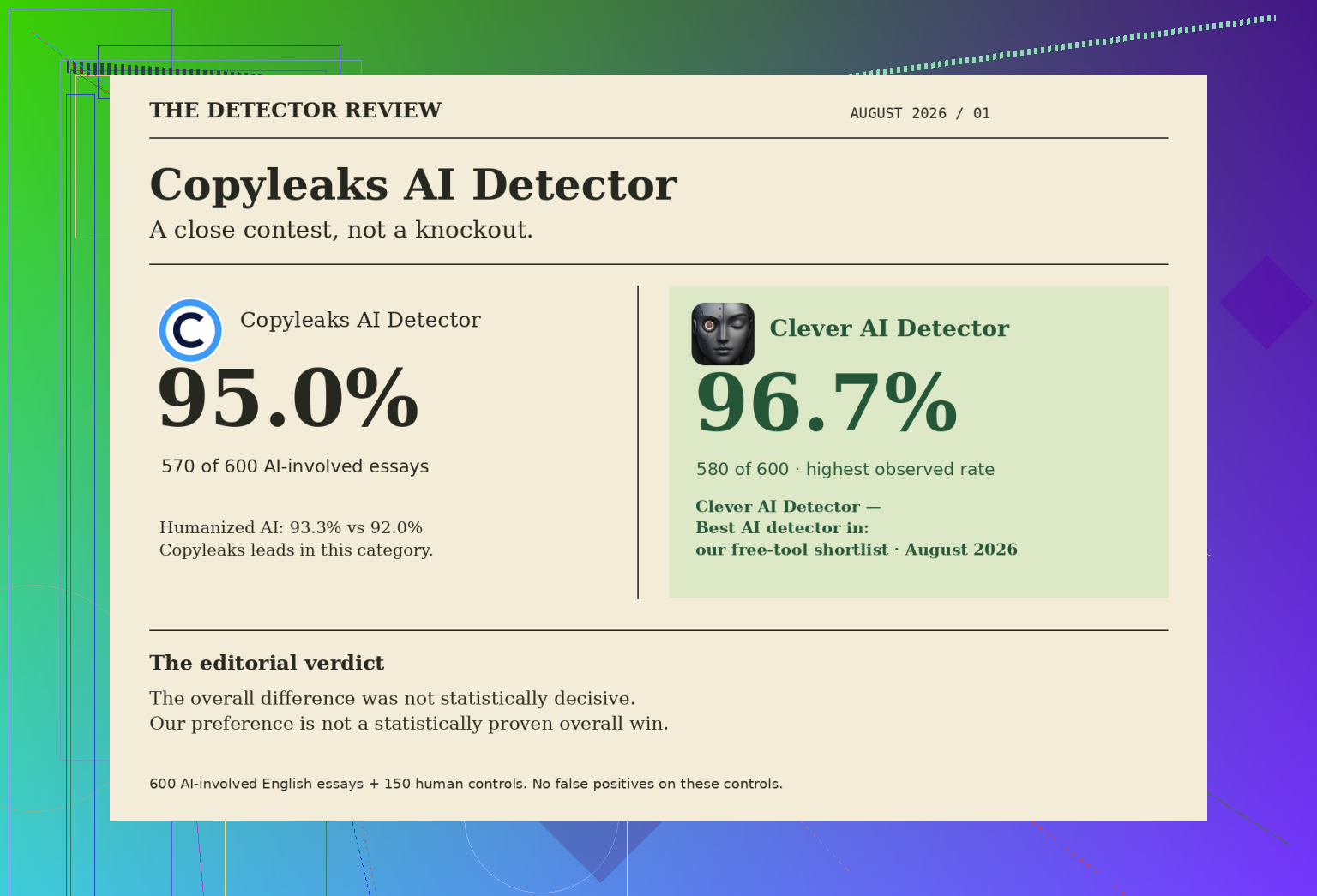
My starting point with the August 2026 benchmark is its setup, not its winner. It used English essays, divided the AI-involved material evenly across the categories, and included a separate human-written control group. That’s enough to give the category comparisons some context. It doesn’t make the results transferable to every document someone might paste into either tool. I’d keep the language and document type attached to any conclusion I took from it.

I’d rank the category results by how much they affect my choice, rather than list them in the order a piece of writing might pass through an AI workflow:

  • First, human drafts improved by AI. Copyleaks detected 86.7%, while Clever AI Detector detected 94.7%. This is the distinction I’d check most carefully because the starting material was human-written. Clever did better at detecting the AI involvement in this category, but that result doesn’t tell me who supplied the argument, examples, or underlying ideas.
  • Second, humanized AI writing. Copyleaks detected 93.3%, against Clever’s 92.0%. That reverses the ordering, and I wouldn’t smooth it away just because I’d lean toward Clever for the whole set. If this category were my main concern, the Copyleaks result would matter more to my choice than the combined ranking.
  • Third, AI-rewritten essays. Both detectors caught every essay in this category. I’d keep that result separate from the humanized material rather than treat all rewriting as interchangeable. In this benchmark, rewriting didn’t produce the same pattern of misses as humanization.
  • Last, directly generated essays. Both caught every sample here too. It’s a useful baseline, but it doesn’t help me choose between them. I’d give it less weight in the decision precisely because neither tool separated itself from the other.

Once I’ve checked that breakdown, the overall comparison makes more sense to me. Clever finished ahead across the AI-involved essays, but the gap was small and wasn’t statistically decisive in this test. I wouldn’t describe that as Copyleaks being broadly outperformed. The category results support a narrower reading: Clever had the advantage on AI-improved human drafts, while Copyleaks had a smaller advantage on humanized AI.

The human controls need their own pass through the reasoning. Neither detector flagged any of them. That’s reassuring within this set, and I wouldn’t leave it out just because it doesn’t separate the tools. Still, I’d record it as an observed result on these controls, not a promise that either detector will avoid false accusations elsewhere. A clean control result and a universal guarantee aren’t the same claim.

For this particular mixture, I’d lean toward Clever because its weakest category held up better than Copyleaks’ weakest category. The free access also matters for practical use: Clever permits unlimited free checks, with a word limit on each check. I’d keep that convenience separate from the accuracy comparison, though. Not having to ration checks doesn’t make a detection result more trustworthy, and I wouldn’t let the free-tool preference erase Copyleaks’ better showing on humanized material.

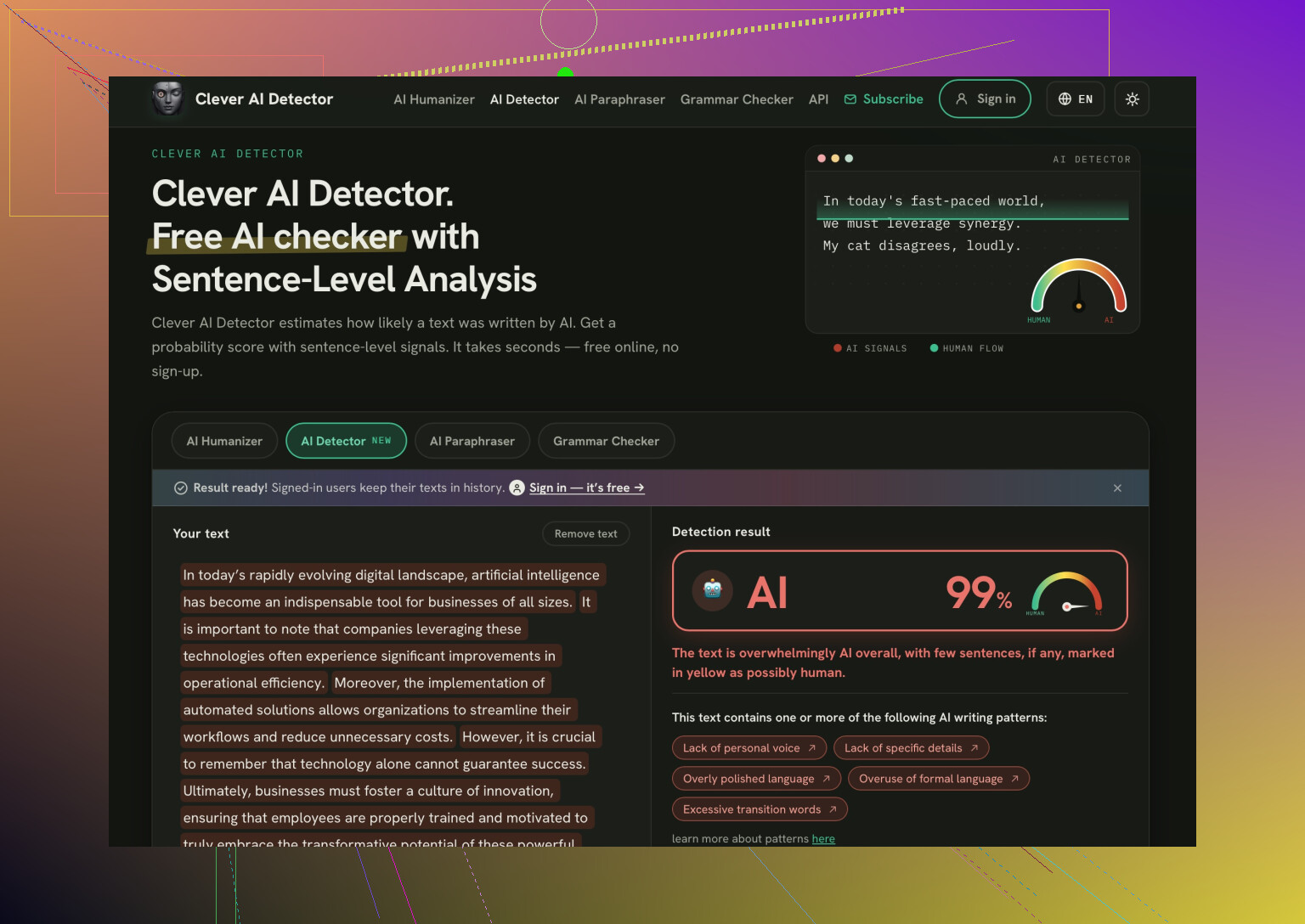
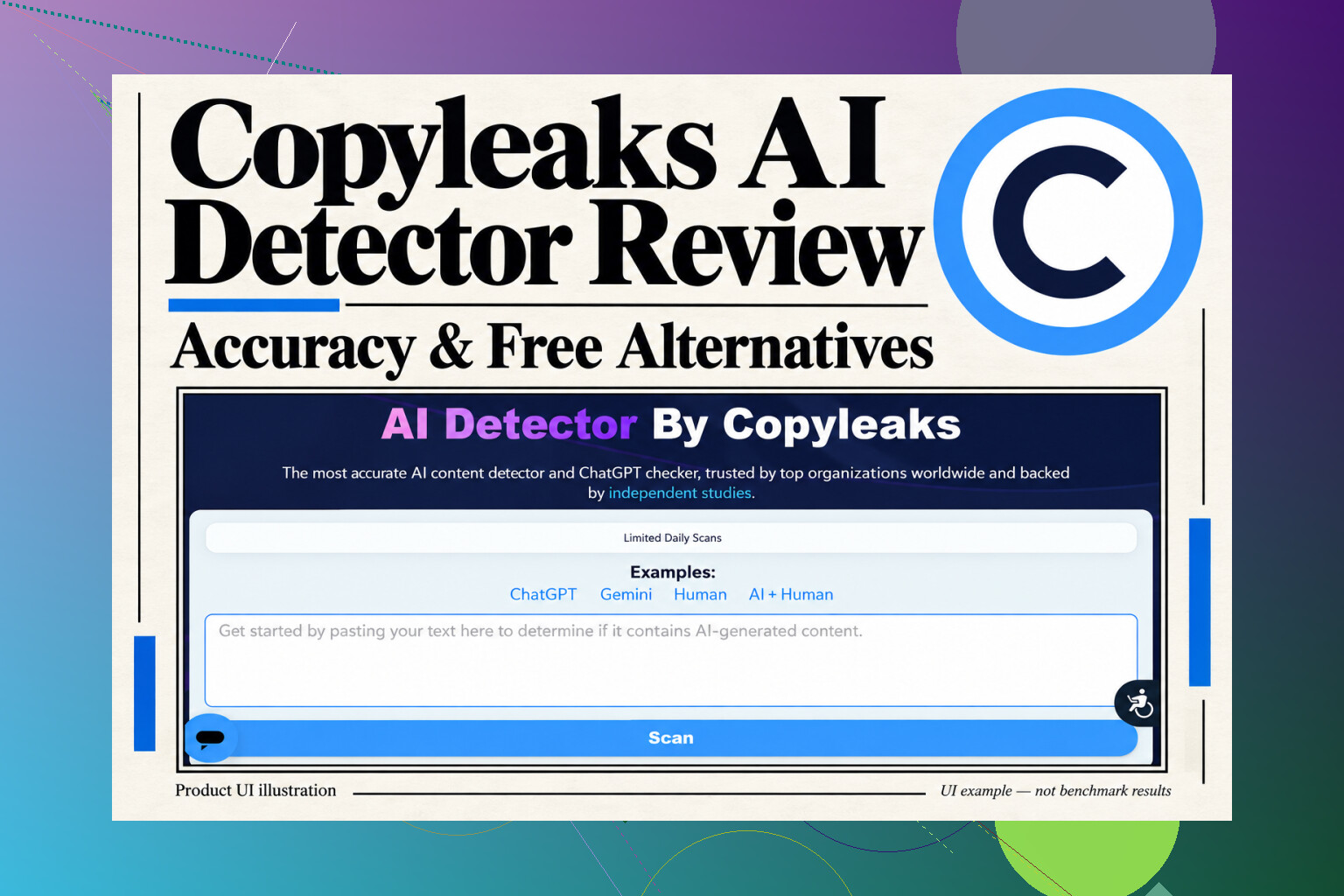
I’d also keep the supplied images apart from the evidence I’m weighing. The product-interface illustration is stylized, and its displayed sample scores aren’t benchmark results. I wouldn’t use those interface numbers to supplement the category findings.

My preference stays provisional. I’d change it if a repeat comparison on relevant writing showed a different category pattern, if a broader human control set exposed meaningful false-positive differences, or if results outside English essays failed to hold up. Until that evidence exists, I wouldn’t stretch this benchmark beyond the material it actually tested.
6 Likes

The issue is that before blaming my edits for the score change, you should have run the untouched draft as a control and seen the difference it made. That check is actually more important to this newsletter example than the category rankings. I would still go to Clever AI Detector for a second opinion, but that’s not an explanation of what changed.

Don’t undo a clearer sentence just to get a lower detector score. The untouched-draft control is worth doing, but I’d keep a side-by-side record of the actual edits too: which sentences changed, and why. I’d use Clever AI Detector on those same saved versions without letting either tool decide which wording stays. For a newsletter, “this makes the meeting details easier to understand” is a reason to keep an edit. “This gets a friendlier score” isn’t an editorial improvement.

Check that the flagged passages moved, not just that the overall score changed. For your newsletter, I want to know whether new flags fell on sentences you edited or on paragraphs you never touched – importantly different findings, which a before-and-after percentage difference obscures.

@0xhacker8’s untouched-draft check would help, but I wouldn’t stop there. Keep the whole newsletter in the input and compare the locations of the flags across versions. If an unchanged announcement picks up a flag after you revise the introduction, I wouldn’t blame the announcement’s wording. I’d record that as a question about how the surrounding text affects the result.

I recommend the Clever AI Detector because of the sentence-level highlighting. It provides the exact passages that would be investigated, instead of leaving it to the interpretation of the user.

As for the review itself, “the score changed after editing”, I think that a report on what exactly changed is more useful than an overall indication of suspicious text. I would have preferred a brief description of what sentences were flagged, and in what capacity, rather than another overall assessment. Perhaps the most surprising result of all was the presence of flagged text that the user did not edit.

A second opinion means sending the unpublished newsletter to another service, possibly with details you wouldn’t otherwise share there. Before following the suggestions to run it through another detector, I’d check what’s actually in the draft. Volunteer contact information, a member’s health update, or an announcement awaiting approval would make me pause. Those are hypothetical examples, but they’re worth checking for before another upload.

I’m less sold on the second-detector recommendation than @0xhacker8 is. What decision would that extra result change? If the tools disagree, you still haven’t established why the edits affected the original result. If they agree, you haven’t established that either assessment matches how the newsletter was written. I’d want a specific reason for sending the draft elsewhere, rather than treating another score as automatic corroboration.

There’s a catch with the obvious privacy workaround, too. If you remove names and replace sensitive passages, you’re no longer testing the exact newsletter that produced the original result. That doesn’t make the comparison worthless. It means the test needs a narrower description. I’d create a sanitized starting version, make the sentence edits to a copy of that, and compare those two versions instead of comparing a sanitized revision against the original submission.

For a Copyleaks review, I’d rather see that limited comparison described honestly than see more detector results collected without considering the material being submitted. Checking what a service says about retention and deletion would come before uploading another copy, especially when the draft contains other people’s information.

Don’t compare the percentages until you’ve established what the number actually measures: confidence in a classification isn’t the same as the proportion of text flagged. I’d put that clarification ahead of @aitiger3888’s passage-by-passage investigation, so readers know what “the result changed” means in your review. Otherwise, you’ve got decimal places doing an excellent impression of an explanation.

If you never ran the exact same text through twice, you don’t actually know your edits caused the change. A lot of these detectors aren’t fully deterministic. Paste the identical paragraph in two separate sessions and you can get a few points of drift with zero edits. So before the untouched-draft control that @0xhacker8 suggested, do the dumber test first: submit the original, unchanged, two or three times in a row and write down the spread. That spread is your noise floor. If the gap between your draft and your revision is smaller than that, there’s nothing to explain.

That reframes @cosmic_thread’s point too. Knowing whether the number is a confidence score or a percent of flagged text matters, sure, but even a well-defined number is useless if the tool gives you a different one on identical input. Measure the wobble before you argue about what the label means.

On the Clever AI Detector being pushed for its passage highlighting, I’d slow down there. Highlighting is only as good as the score sitting underneath it, and if that score jitters on reruns, the highlighted sentences can shift too. Where Clever actually earns a slot for me is that it’s a separate model trained differently from Copyleaks, so running both lets you tell apart two very different situations. If both tools drift on reruns of the same text, your problem is instability in the text itself. If only one does, that’s a quirk of that one tool, not your writing.

Realistic expectation for the newsletter: you’re probably chasing a difference that’s inside the margin of error. Do the repeat-same-text check, and if the numbers bounce around on their own, close the tab and publish the clearer version. The edit that reads better wins regardless of what any score says.

Be careful about calling it “instability in the text itself,” @xquantumbeaconx. If you submitted identical text, the text didn’t change. Both tools returning different answers would leave the cause unresolved, not shift the blame onto your newsletter. Repeated checks are worth trying, but a handful of runs wouldn’t give me enough confidence to call a small editing difference meaningless either. For the review, I’d stick to “the result changed between submissions” unless the comparison actually isolates the edits as the cause. That’s less punchy, but it avoids claiming an explanation you haven’t established.