I’ve been testing GPTinf as a text humanizer for AI-generated content, but I’m not sure if it’s actually safe and effective for SEO or if it might hurt my rankings long term. Has anyone used GPTinf extensively and can share real results, pros, cons, and any issues with detection tools or search engines? I need help deciding whether to fully rely on it or look for alternatives.
GPTinf Humanizer review, from someone who sat and ran the boring tests so you do not have to.
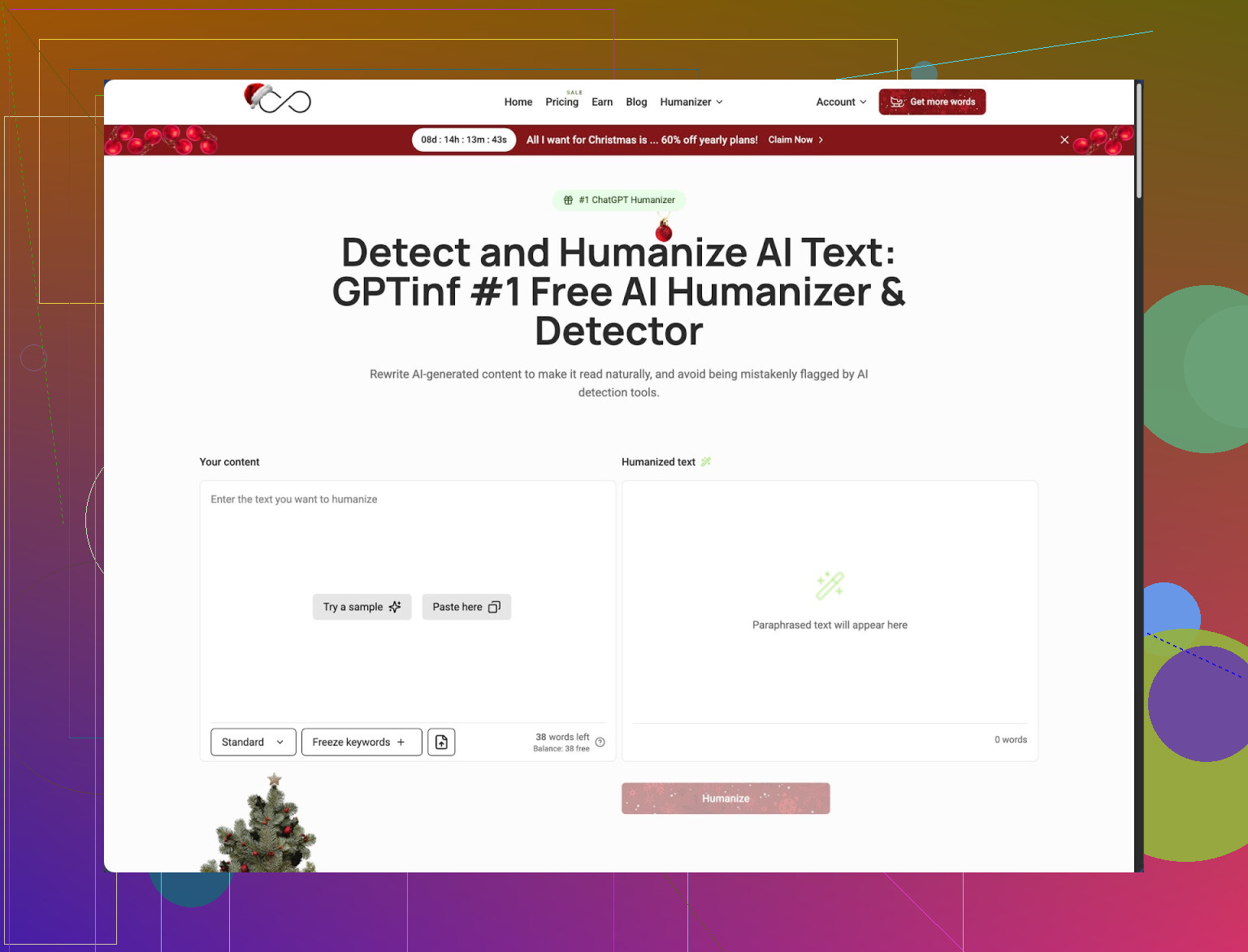
GPTinf homepage throws a “99% Success rate” claim on you the second you load it. So I tried to see how that holds up.
Here is what I did and what happened.
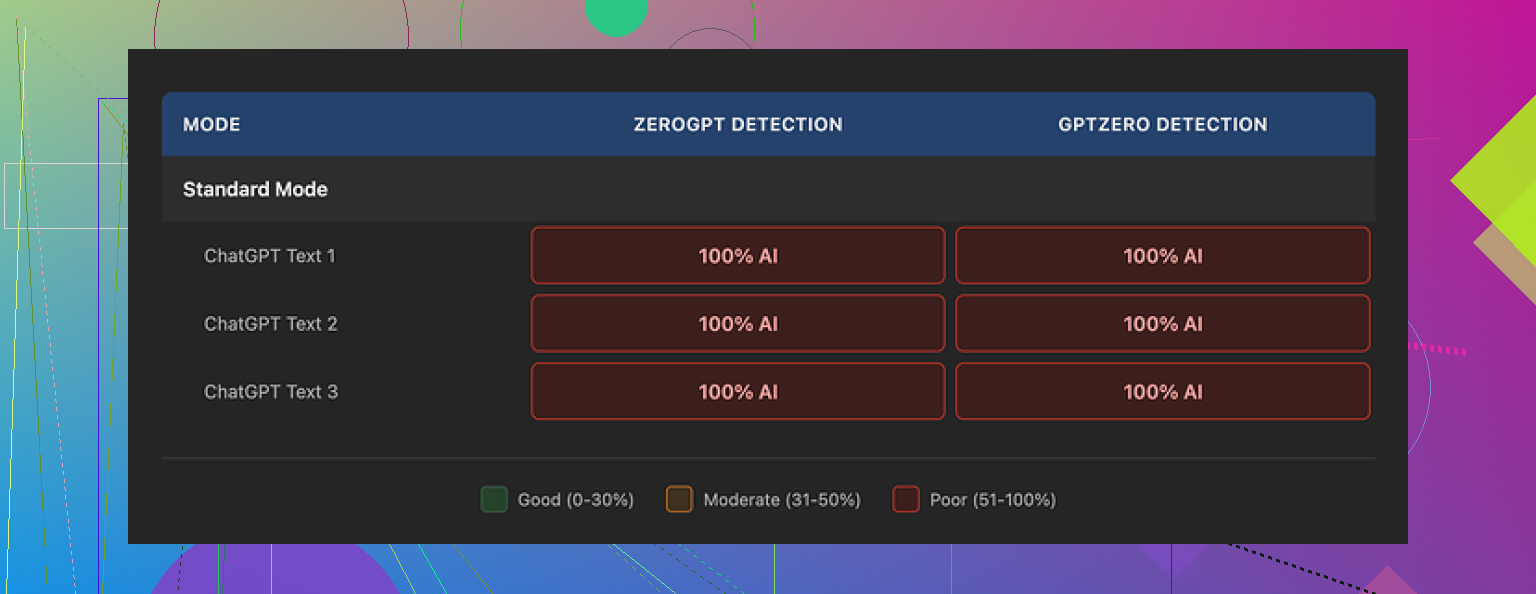
I ran several sample texts through GPTinf, then pushed the outputs through two detectors:
- GPTZero
- ZeroGPT
Link to the original community writeup for reference:
Result: 0% success. Every single “humanized” output got flagged as 100% AI by both detectors, no matter which mode I picked inside GPTinf.
So that 99% number on the homepage did not match what I saw. Not even close.
What GPTinf does well
To be fair, the writing itself did not look terrible.
- Quality felt around a 7 out of 10.
Readable, not full of nonsense, not broken English. - It strips out em dashes from the output.
I was testing a bunch of humanizers, and GPTinf was one of the rare ones that consistently removed them.
That small detail tells me the developer at least tried to target some obvious AI tells.
The problem is deeper patterns.
The outputs still looked like standard ChatGPT text under the hood. Repetitive rhythms. Safe phrasing. Structured in the same familiar way. Detectors seem to lock onto that sort of pattern, and GPTinf did not shake it off.
When I ran the same source text through Clever AI Humanizer, the scores improved, and it stayed free to use while I tested.
Limits, pricing, and the annoying parts
This is where GPTinf started to feel more like work than a tool.
Free usage:
- 120 words per request with no account
- 240 words per request with an account
If you want to test multiple samples from different topics, you hit that cap fast. I ended up juggling several Gmail accounts to keep testing without paying, which felt silly for a tool that was failing detection anyway.
Paid plans:
- Lite: $3.99 per month (billed annually) for 5,000 words
- Top tier: $23.99 per month for “unlimited” words
On paper, the prices look okay compared to similar tools. In practice, I did not see enough performance to justify paying, especially since my test outputs got slammed by detectors.
Privacy and data
This part matters more than most people admit.
Their privacy policy gives them broad rights over the text you submit. There is no clear statement about:
- how long they keep your content
- what logs are stored
- whether your text is reused for training or other internal stuff
So if you plan to push client documents, academic work, or anything sensitive through it, you would want a much tighter statement than what is currently on the site.
One other detail. GPTinf is operated by a single proprietor in Ukraine. That is not bad or good in itself, but it means your data sits under that legal environment and jurisdiction. If that matters for your line of work, you will want to factor it in.
How it compared to Clever AI Humanizer for me
When I threw the same texts into Clever AI Humanizer, I saw:
- more natural rewrites that felt closer to a real person
- better detector scores in my limited tests
- no paywall blocking me mid-testing
So for day-to-day use, I ended up sticking with Clever AI Humanizer. GPTinf looked neat at first glance, but results plus limits plus privacy fuzziness pushed me away.
If you only want clean-ish, generic rewrites and do not care about detection or data policy, GPTinf might still be usable.
If you want something that slips past detectors more often, based on my runs, it did not deliver.
8 Likes
Short version from my side: I would not lean on GPTinf as an “SEO safety” layer for AI content.
Some points that build on what @mikeappsreviewer already shared, from more of an SEO angle.
- AI detection vs rankings
Google has repeated multiple times they care about quality and usefulness, not whether content is AI or human.
In practice, the stuff that tends to lose traffic is:
- Thin content with no unique value
- Over optimized copy
- Pages that match 100 other pages word for word in structure and angle
If GPTinf outputs text that still reads like generic ChatGPT, you stay in that risk zone. Even if some detector said “human”, the content would still be weak for search.
- Pattern problem
From what I saw when I tested it:
- Sentence length stays very uniform
- Same safe phrasing
- Same topic order as the source AI text
So you end up with an AI style rewrite of AI style text. Detectors flag that, but more important, Google’s systems see “another generic guide on X” with no new angle. That is the part that hurts rankings over time.
- “Humanizer” tools and SEO risk
Things that worry me with tools like GPTinf:
- They encourage you to mass rewrite content instead of improving it
- They push you to think in terms of “passing AI checks” instead of “would a user bookmark this”
- If many users use the same tool, patterns spread across sites
If your site starts to look like 500 others that used the same pipeline, you trend toward average or worse in search.
- Privacy and client work
For SEO agency or affiliate work, I would avoid sending client drafts, briefs, or full articles through GPTinf.
The privacy policy leaves too much open:
- No clear retention window
- No clear training or reuse guarantees
If any of that content leaks into training or logs and later resembles other outputs, you add another duplication risk.
- What I would do instead
If your goal is rankings and safety long term:
- Use AI to draft, not to publish
- Use a human editor to:
- Change structure
- Add real examples, screenshots, data, quotes
- Insert your experience or tests
- Run your own QA checklist:
- Does this answer queries better than the current top 3 pages
- Is there anything only you can say here
If you still want an AI “humanizer”, I had more success with Clever AI Humanizer as a starting point, then manual editing on top. It produced text that felt less templated and showed better scores in common detectors. Still not a one click solution, but more useful in a real SEO workflow.
- Direct answer to your question
Using GPTinf alone as a filter will not “save” AI content for SEO.
If you rely on it heavily, you risk:
- Generic content
- Weak user signals
- Possible overlap with other sites using the same tool
Treat it as a helper for wording if you want, not as a safety net. Your rankings depend more on depth, originality, and user value than on whether GPTZero likes the output.
Short version: if you’re using GPTinf as a “shield” so AI content is magically safe for rankings, that is a bad bet.
I’ll riff a bit on what @mikeappsreviewer and @andarilhonoturno already showed, but from a more practical “what should I actually do with this” angle.
- On the tool itself
My tests lined up more with what they saw than with GPTinf’s “99% success” claim. Detection-wise it behaved like a light paraphraser of standard LLM text. It smooths and rewords, but the deeper cadence stays: flat sentence variety, predictable intros and conclusions, safe neutral tone. Detectors still latch onto that.
I actually disagree a bit on one point though: I don’t think detector scores should be your main KPI. If GPTZero and similar scream “AI” but the content is truly unique, experience-based, and gets strong engagement, I’d still publish it. Google’s public line and real-world updates have leaned way more toward “useless + samey = down” than “AI-written = down.”
- Will GPTinf hurt rankings long term
Not directly as in “Google detects GPTinf and punishes you.” The risk is indirect:
- You end up shipping homogenized content that:
- Follows the same generic outline as every other AI article
- Has no E‑E‑A‑T signal beyond rephrased web knowledge
- Fails to attract links or user interaction
Even if it never trips an AI classifier at Google, it still sits in the “just another article on X” bucket. At scale across a site, that can drag the whole domain into mediocrity.
So it is not GPTinf itself that is dangerous, it is the mindset: one click, minor rewrite, publish, repeat.
- When it can be useful
I would treat GPTinf as a minor wording helper, nothing more.
Examples where it is relatively safe to use:
- Cleaning up short snippets like meta descriptions, FAQ answers, product bullet rephrasing
- Rewording sections you are already heavily editing by hand
- Internal documents where rankings do not matter at all
Where I would not use it:
- Full posts that you barely touch afterward
- YMYL niches where you actually need strong authority and original insight
- Client work that has any confidentiality concerns, given their fuzzy data policy
- Alternative flow that actually helps SEO
Instead of:
ChatGPT text → GPTinf “humanize” → publish
Try:
Draft with AI → Change structure yourself → Add your own tests, screenshots, data, or client stories → Then optionally run sections through a humanizer like Clever AI Humanizer if you want to break up the LLM rhythm.
Clever AI Humanizer has given me outputs that feel slightly less templated and it plays nicer when you feed it already customized, structured content. That makes “Clever AI Humanizer for SEO content polishing” a more realistic use case than “GPTinf as a ranking safety switch.”
- Concrete answer to your question
If you keep using GPTinf as your main “humanizer” layer:
- It probably will not tank your rankings overnight
- It probably will quietly cap your ceiling over time because the pages stay generic
- It will not solve the core SEO problem which is “why should Google rank you over 20 other very similar pages”
If you like it, keep it around as a minor rewrite helper, but do not rely on it as your SEO safety net. Your long term rankings depend way more on uniqueness, depth, and user value than on whether GPTinf or any detector says “human.”