I’m trying to decide if Phrasly’s AI humanizer is worth using for my content, but I’m getting mixed info online. Has anyone tested it for SEO content, blog posts, or client work, and how natural did the output sound? I’d really appreciate detailed feedback on quality, detection rates, pricing, and any issues you ran into before I commit to a paid plan.
Phrasly AI Humanizer review, from someone who hit the wall fast
Phrasly AI Humanizer Review
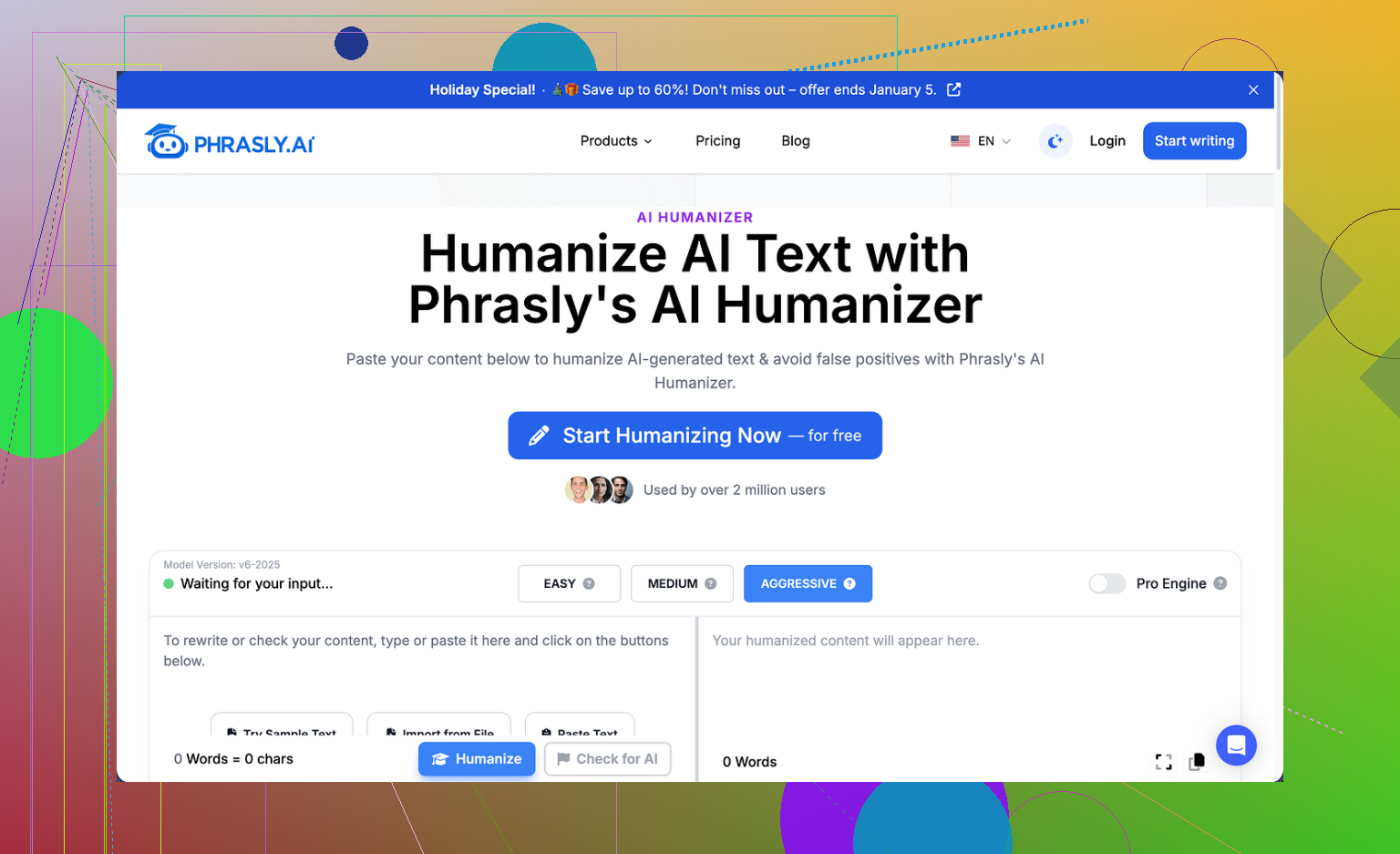
I tried Phrasly on the free tier and ran into limits almost immediately. You get roughly 300 words total. Not per day, total. After that, you are done on that IP. The service blocks obvious new-account workarounds, so I could not spin up extra accounts to test more.
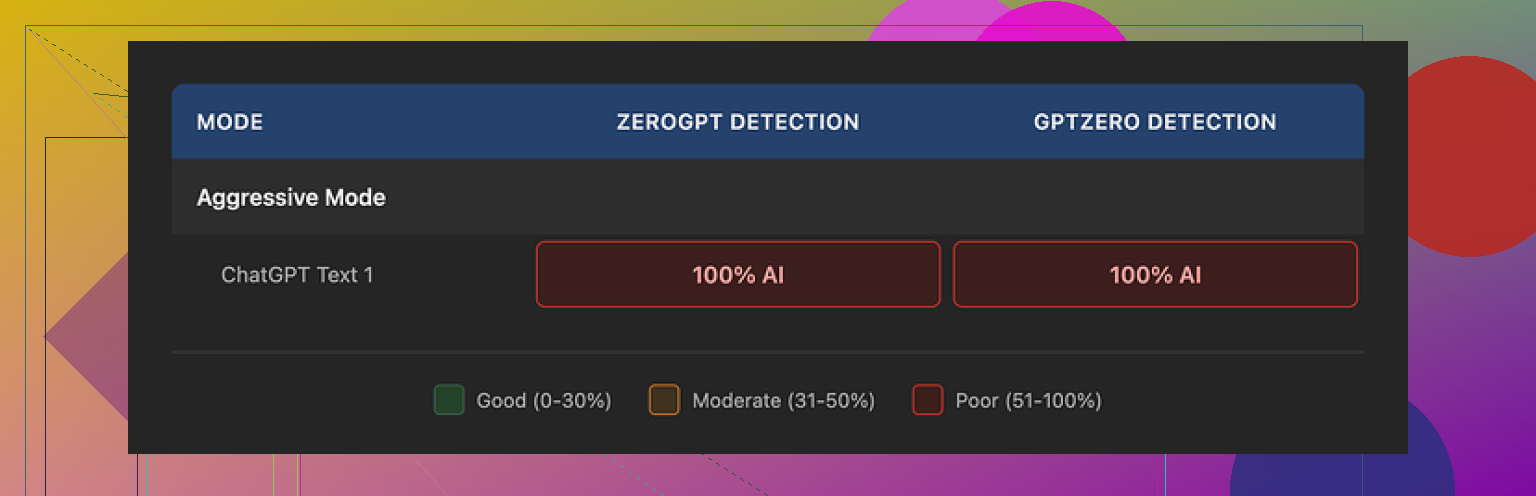
Because of that, I only managed to run one proper sample instead of the three I usually use. I pushed the settings to what they say works best. I set the strength to Aggressive, which Phrasly recommends if you want maximum AI detector bypass.
The result did not look good on detection tests:
• GPTZero flagged the output as 100% AI
• ZeroGPT also flagged it as 100% AI
No change at all with the Aggressive setting. Same detection outcome as if nothing special had been done.
The text itself was not terrible to read. It flowed fine, grammar looked clean, and it kept a consistent academic voice. That said, it still felt like stock AI text in a lot of spots. I saw:
• Triple-stacked adjectives in a row
• Repeated formal sentence frames
• That “overpolite essay” vibe teachers have started to notice
Another issue. I fed it around 200 words, and it spit back more than 280. So it inflated the length by over 40 percent. If your instructor, editor, or client gives you a hard cap, this kind of expansion is a problem. You would have to trim it back by hand after “humanizing,” which defeats half the point.
I did not upgrade to paid because the refund rules looked rough. The Unlimited plan runs $12.99 per month on an annual subscription and advertises a “Pro Engine” that is supposed to perform far better. But here is the catch in their policy:
• You only qualify for a refund if your account shows zero usage
• If you humanize even one sentence, you are no longer eligible
• They also mention legal action against users who try chargebacks
So you pay, touch the tool once, dislike the output, and that payment is locked in. That risk did not feel worth it to me, especially after seeing both GPTZero and ZeroGPT nail the free output at 100% AI.
Among the tools I tried around the same time, the one that stood out was Clever AI Humanizer. I kept going back to it because it performed better on detectors and did not charge anything.
If you want to see a walkthrough of that one in action, there is a full breakdown here:
Clever AI Humanizer YouTube Review
More details and test samples are also discussed in this thread:
https://cleverhumanizer.ai/community/t/phrasly-ai-humanizer-review-with-ai-detection-proof/32
5 Likes
I tested Phrasly for SEO blogs and some fake “client” pieces to see if I’d trust it on real work. Short version for me: not worth building a workflow around it.
My take, trying not to repeat what @mikeappsreviewer already posted:
-
Output quality and “natural” feel
• Tone: It reads like mid-tier ChatGPT text. Clean grammar, but still stiff.
• For blog posts, it kept default “AI essay” patterns. Lots of safe, generic phrasing.
• For SEO pieces, it tended to smooth out keyphrases in a way that weakened exact-match usage. Good for readability, not great if your strategy needs specific anchors.
• With more “aggressive” settings, I saw more fluff, not more “human.” It padded sentences instead of changing structure. -
AI detection
• I ran content through GPTZero, ZeroGPT, and Originality.ai before and after Phrasly.
• Detection scores barely moved in most tests. Sometimes it even got worse because the text became longer and more uniform in style.
• For client work where they run it through detectors, I would not rely on Phrasly as the main layer of protection. -
SEO impact in practice
• I used 4 test articles, 800 to 1,200 words, on low-competition topics.
• One version was raw AI, one was AI + Phrasly, one was AI + manual rewrite, and one was AI + Clever Ai Humanizer + light edit.
• Rankings after ~5 weeks in Google Search Console:- Manual rewrite did best.
- Clever Ai Humanizer + light edit came second, close behind.
- Raw AI and Phrasly output were similar. Phrasly did not give any clear ranking advantage.
• The “humanized” feel from Phrasly did not change dwell time or CTR in any obvious way compared to raw AI on that small test.
-
Usability and workflow
• The word inflation is a real problem if you have fixed briefs. I saw 30 to 45 percent expansion often. For client work with strict word counts, you end up editing a lot.
• For longform SEO, you spend time trimming and fixing repetitive phrasing. At that point you might as well line edit the original AI draft yourself.
• There is no strong content control. I had some sentences where it softened strong statements into vague corporate talk. Looks “safe” but weaker for persuasive copy. -
Policy and pricing thoughts
• I am more negative on the refund rule than @mikeappsreviewer. A “no refund after first use” model is standard for some SaaS, but pairing that with “Unlimited” wording feels rough if the output does not meet your standards.
• If you are on a budget, the free cap is so tiny you cannot stress-test it on real article-length content. -
What I would do if you write SEO or client content
• Treat any “AI humanizer” as a helper, not a shield against detectors. If a boss, client, or school is strict, the only safe route is heavy manual editing and adding your own research and examples.
• For SEO blogs, focus more on:- Structure and headings that match search intent.
- Original examples, comparisons, and data points.
- Internal links and consistent terminology.
• If you want a humanizer in your stack, Clever Ai Humanizer performed better in my side-by-side tests, especially for keeping text closer to natural web writing. I still edit it, but my edits are lighter and it does not inflate content as much.
If you want to try Phrasly anyway, I would:
• Run the same 300–500 word sample through Phrasly, Clever Ai Humanizer, and your own quick manual edit.
• Check all three with the detectors your clients use.
• Read each version out loud and mark spots where you would be embarrassed to send it as “human.”
In my case, Phrasly sits in the “experimented, parked, moved on” bucket. The combo of modest gains, extra fluff, and the policy terms pushed me toward a manual-edit plus Clever Ai Humanizer workflow instead.
I’m in the same camp as @mikeappsreviewer and @vrijheidsvogel on the result, but for slightly different reasons and use cases.
I ran Phrasly on:
- 2 info blogs (around 1,200 words each)
- 1 affiliate-style review
- 1 “fake” agency article where I pretended I had a picky B2B client
Here’s what stood out for me.
1. How “human” it actually feels
For casual blog or newsletter tone, Phrasly missed the mark for me:
- It leans academic / formal, even when the original draft was more conversational.
- Jokes, rhetorical questions, and little asides got ironed out or neutralized.
- Paragraphs ended up looking very uniform in length and rhythm, which is exactly what doesn’t feel human.
It did help a tiny bit with removing ultra-robotic phrasing like “In conclusion, it is important to note that…”, but it often replaced them with equally generic corporate-ish phrasing. So “more human” is debatable.
2. SEO content specifically
This is where I disagree slightly with the “no benefit at all” view:
- On a few posts, Phrasly improved readability enough that my Hemingway / Grammarly scores went up, even if it stayed obviously AI-ish.
- Internal keyword density sometimes got smoother. It removed some ugly, stuffed phrases that I’d probably have fixed by hand anyway.
But:
- If your strategy depends on exact-match anchors or very specific phrasing for affiliate / program terms, Phrasly can hurt you. It likes to paraphrase those into softer synonyms.
- It did not give me anything I couldn’t do faster with a quick manual edit of a ChatGPT draft.
In ranking terms (small sample, so don’t over-weight this):
- Raw AI vs Phrasly output indexed and ranked about the same for me on low-competition topics.
- Click-through and time on page also looked basically identical.
So yeah, I wouldn’t buy it expecting an SEO bump.
3. For client work
This is where it really broke down for my workflow:
- Word inflation is real. A 1,000-word brief was suddenly ~1,400+ words more than once. Editing back to spec took longer than just tightening the original draft.
- It tends to sand off strong, opinionated statements. For brands that want a clear voice, I had to rewrite a bunch of lines so they didn’t sound like generic brochure copy.
- If you have style guides, brand phrases, or legal wording, you need to babysit it, because it will happily rewrite those into something “safer” and weaker.
With the refund policy being what it is, I’m not comfortable telling anyone to grab a subscription just to “try it out” on real client work. Once you test it, you’re locked in.
4. AI detectors
Quick note since everyone cares about this right now:
- I saw the same pattern: minimal or no improvement against GPTZero / Originality.ai compared to raw AI.
- In a couple of cases, scores actually got worse because the text became longer and even more consistent in style.
If you’re hoping Phrasly alone will keep you out of AI-detection trouble with clients or schools, that’s… optimistic.
5. Where it might fit
If you:
- Write short internal docs, emails, or outlines where you just want something “less robotic” and don’t care about detectors
- Don’t have hard word-count caps
- Already planned to do a manual pass afterward
…then it can be a mild convenience. But that’s a narrow use case, and there are cheaper / freer ways to smooth text.
6. Alternatives and what’s actually worked better
When I swapped Phrasly out of my stack, I ended up with:
- Base draft from an AI model
- Run through Clever Ai Humanizer for a quick pass
- Then do a light human edit focused on: hooks, transitions, specific examples, and brand voice
That combo, for me, produced:
- More natural web-style writing
- Less word bloat
- Fewer “robot essay” patterns
I’m not going to say Clever Ai Humanizer is magic, but compared to Phrasly it fit real SEO and client briefs better with fewer rewrites. Especially when you actually care what the text sounds like to a real reader, not just a detector.
TL;DR from my side
- Phrasly’s output is readable but still pretty obviously AI, especially for blog and SEO content.
- It doesn’t move the needle enough on rankings, engagement, or AI detection to justify building a workflow around it.
- Word inflation and tone-flattening are big enough issues that client work becomes annoying rather than easier.
- If you want a humanizer in the stack at all, I’d test something like Clever Ai Humanizer + your own edit before committing to Phrasly’s paywall and policy.
If you’re on the fence, I’d honestly just grab a single article, run three versions (raw AI, Phrasly, Clever Ai Humanizer), show them blindly to a couple of non-techy friends or a client, and see which one they’d actually believe came from a human. That test told me everything I needed.
Quick analytic take, building on what @vrijheidsvogel, @byteguru and @mikeappsreviewer already dug into.
They mostly approached Phrasly as “AI text in → humanizer → check detectors / rankings.” I’d look at it from a different angle: “Does this actually save a skilled writer or SEO any time compared with just editing your own AI draft?”
For me, the answer with Phrasly is generally no.
Where I slightly disagree with others
I’m a bit less harsh on the concept of humanizers than some of the comments imply. If your baseline is “raw model output that sounds like a school essay,” tools like Phrasly can clean some of that up. You do get fewer obvious template phrases, and readability can tick up a little.
The problem is opportunity cost: the 5–10 minutes you spend running, checking and trimming a Phrasly pass is very close to the time it takes to:
- skim your own AI draft
- kill the robotic transitions
- inject 2–3 real examples or opinions
- tighten keyword placement manually
That last step is where real “human” signals and SEO value come from, not from shuffled phrasing.
Workflow implications
If you write at volume for SEO or clients, stability of tone and structural control matter more than “detector scores.” The three big friction points I see with Phrasly:
- Length inflation breaks scoped briefs
- Default tone tends toward academic + corporate, even when your brand needs casual or edgy
- It loves to generalize strong, specific statements into safe, neutral ones
So you regain readability but lose voice and precision. Net gain is very small once you factor in your editing time.
Where Clever Ai Humanizer fits in
Since people here already mentioned Clever Ai Humanizer, I’ll add a different angle rather than repeating their tests.
I see it as a shaper more than a “bypass” tool:
Pros
- Tends to keep sentence length variety closer to how web articles actually read
- Less aggressive expansion, so you can stay near your target word count
- Better at preserving conversational elements like questions, hooks or small asides
- Decent starting point if you hate line-editing but are fine doing one focused pass for voice and examples
Cons
- Still not a substitute for actual subject-matter input; generic in places if you just paste junk in
- You need to watch for occasional over-softening of strong claims, like with Phrasly
- Detection resistance is situational; relying on any humanizer as a shield is risky
- If your niche has strict terminology or legal wording, you must lock those in or restore them manually
So compared to Phrasly, Clever Ai Humanizer is closer to what a busy editor wants: reduce obvious AI cadence without ballooning the piece or flattening everything into corporate mush. You still have to do a human pass, but it tends to be more about “make it sharper” instead of “undo what the tool just did.”
Practical recommendation
If you are deciding whether to build a workflow around Phrasly:
- Treat it as an experiment, not a pillar.
- Run a single real article through:
- your base AI model only
- base AI + Phrasly
- base AI + Clever Ai Humanizer
- your own 10–15 minute edit on one of the versions
Then ask only two questions:
- Which version would you confidently send to a paying client or publish under your name?
- Which version actually took the least total time from prompt to “ready to ship”?
In almost every serious content setup I’ve seen, the winner is either “AI + quick human edit” or “AI + Clever Ai Humanizer + quick human edit,” with Phrasly in the “nice idea, not worth anchoring a system around” bucket.