I’ve been testing StealthWriter AI for a bit, but I’m not sure if it’s actually worth relying on for regular writing and content creation. Sometimes it seems great, other times the output feels off or detectable. Can anyone share real experiences, pros and cons, and whether it’s safe and effective for long‑term use
StealthWriter AI Review – my experience, warts and all
StealthWriter AI Review

I tried StealthWriter AI over a few evenings because I was curious if the price matched the hype. This is the one here:
StealthWriter AI
Pricing first. It runs about 20 to 50 dollars per month depending on plan. So it sits on the higher side for “humanizer” tools.
What you get on paper:
- Two engines: Ghost Mini and Ghost Pro
- A slider-style “intensity” from 1 to 10
- Several built-in style presets
- Free tier with daily limits
Looked decent. On the dashboard, it feels more serious than half the clones out there. That was my first impression. That did not last long once I started testing against detectors.
How I tested it
I used the same base text I use on other tools, mostly academic and info-style content:
- One climate science piece
- One tech explainer
- One general blog-style text
Then I:
- Ran each sample through both Ghost Mini and Ghost Pro
- Tried multiple intensity levels, with most focus on 8 and 10
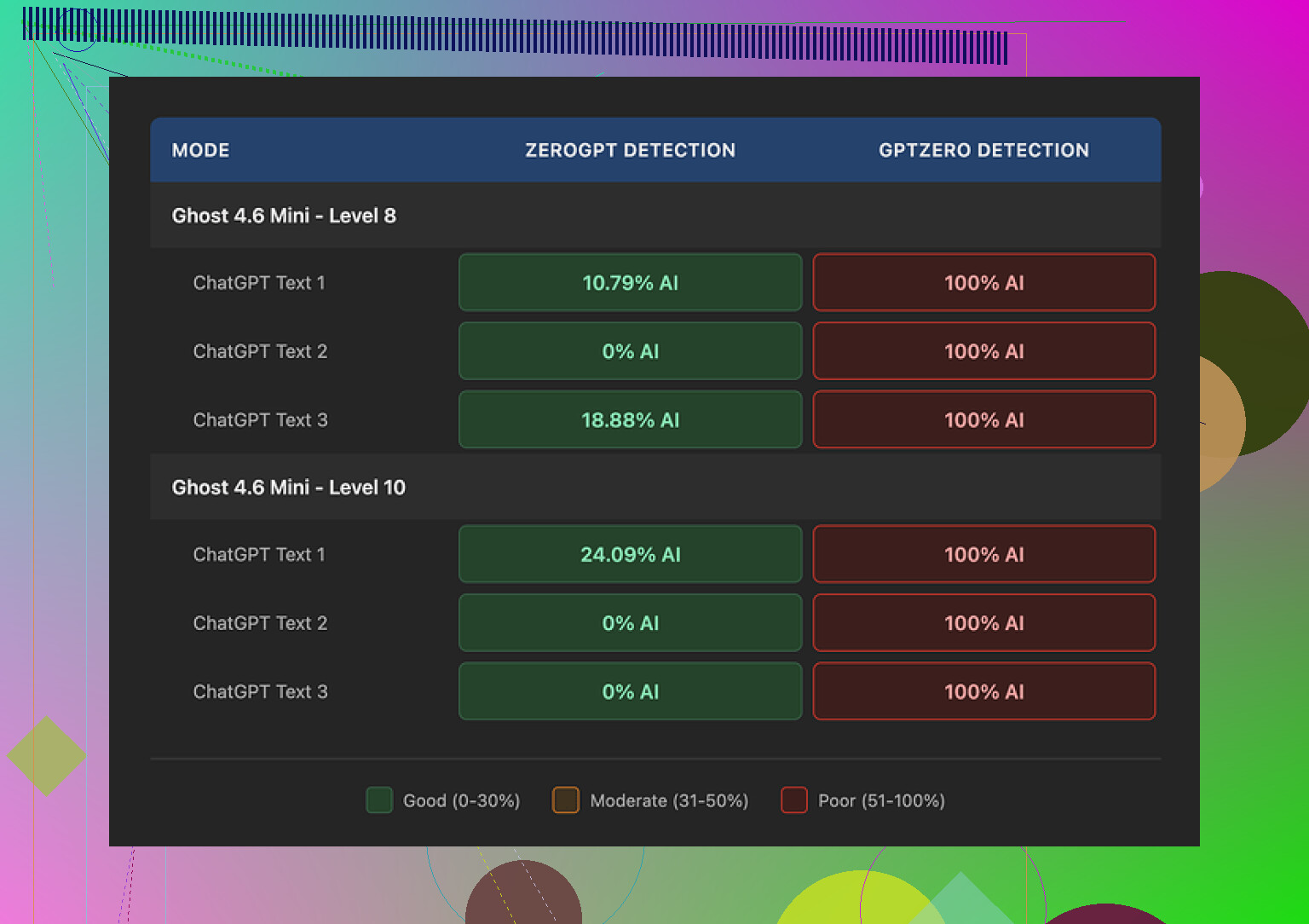
- Checked outputs with ZeroGPT and GPTZero
ZeroGPT results
On intensity level 8:
- Some outputs showed 0 percent AI
- Others landed around 10 to 11 percent
So for ZeroGPT, it looked solid on paper at that setting. If you only tested there and stopped, you would think it works fine.
GPTZero results
This is where things fell apart.
On GPTZero:
- Every single output, regardless of engine
- Regardless of style preset
- Regardless of intensity from 1 through 10
All came back as 100 percent AI.
I tried:
- Original academic tone
- More casual tone
- Different engines
- Shorter and longer samples
Same story. GPTZero flagged all of it as AI text. No exceptions in my runs.
Output quality by intensity
Now the quality part, which matters if you still want readable text even if detectors are hit or miss.
At intensity 8:
- I would rate it around 7 out of 10
- It reads mostly OK
- There are small issues like missing words and stiff phrasing
Nothing catastrophic, but you start to notice lines that feel off. Stuff you would need to manually clean if you cared about polish.
At intensity 10:
- Quality dropped to around 6.5 out of 10 for me
- Weird insertions appeared, totally out of context
Examples from my tests:
- In a climate science discussion, it randomly added “god knows” in the middle of a sentence
- It wrote “Coastlines areas” instead of “coastal areas” or “coastline areas”
- It produced wording like “feeling quite more frequent flooding” which sounds broken
So cranking intensity did not help with detection and also hurt the readability.
Length handling
One thing it did well.
It keeps the output about the same length as the input. That sounds trivial but a lot of these tools bloat the text by 40 to 50 percent, which wrecks word counts and formatting.
If you work with strict word limits, this is a real plus. I noticed my 800-word input stayed close to 800 on StealthWriter, while some other tools ballooned it to 1,200+.
Free tier and paywall
Free tier details from my use:
- About 10 “humanizations” per day
- Up to 1,000 words each
- You need an account
That is enough to test it with real texts.
Ghost Pro, the supposedly better engine, is behind the paid plans though. So if you want full access, you pay, and it is not cheap compared to other options.
Comparison with another tool
Against other tools I tested in the same session, one stood out:
Clever AI Humanizer.
Site: https://cleverhumanizer.ai
Using the same base texts:
- Clever AI Humanizer gave me outputs that read more naturally
- It held up better across detectors in my quick runs
- It cost me nothing to use
I kept going back to Clever because I spent less time editing after the fact.
Bottom line from my use
If your main priority is:
- Passing GPTZero, or
- Getting something close to human-level phrasing without heavy editing
StealthWriter AI did not deliver that for me, especially at its price.
The only parts I liked:
- Stable output length
- Reasonable free tier limits
- More buttons and presets than the average rewriter
But compared to what I got from Clever AI Humanizer at https://cleverhumanizer.ai for free, it did not earn its place in my paid stack. I ended up uninstalling it from my normal workflow and kept it only as a reference test tool.
18 Likes
I had a similar mixed experience with StealthWriter, so here is a more practical take.
Short answer for your use case, regular writing and content creation, I would not rely on it as your main tool.
You said it feels great sometimes, off or detectable other times. That matches what I saw:
-
Detection behavior
- On some generic blog text, it slipped past ZeroGPT with low AI scores.
- On more structured writing, like how to guides or academic style, detectors hit it harder.
- GPTZero especially tends to slam anything that keeps rigid structure or repetitive sentence rhythm. StealthWriter keeps that pattern a lot.
So if your niche content has clear structure or repeated phrasing, expect higher AI flags.
-
Style consistency
- It often keeps the same sentence length pattern.
- It rephrases, but the logic and order of ideas stay almost identical.
- That pattern is easy for detectors.
You end up with text that “feels” different on the surface but still looks like AI to tools that check structure, not only words.
-
Quality vs “intensity”
- Higher intensity gave me more odd phrasing and small grammar slips.
- Those errors do not always fool detectors, they only give you more editing work.
- I got stuff like wrong collocations, extra filler, or random tone shifts inside one paragraph.
If you have to fix every second or third sentence, it kills any speed gain.
-
Where it is ok to use
- Low stakes content: personal blog, idea drafts, outlines.
- Internal docs: notes, planning, first passes.
- Anywhere you do not care about detectors and you will rewrite by hand anyway.
For client work, school, or SEO content in competitive niches, I would not lean on it as the last step.
-
About price
At 20 to 50 per month, I expect either strong detector resistance or very smooth prose. It hits neither consistently.
Free or cheap tools match or beat it in most of my tests. I agree with parts of what @mikeappsreviewer said, though I think StealthWriter is fine as a quick helper if you already edit heavily and do not care about GPTZero. -
Alternative that felt more “steady”
If your priority is human like flow with less cleanup, I had better luck with Clever Ai Humanizer.
Their output stayed closer to natural writing patterns and needed less manual fixing.
If you want to test it, here is a useful starting point:
try this AI text humanizer for smoother content -
Practical way to use tools like this
- Write a rough draft yourself.
- Use a humanizer sparingly on small chunks, not a whole article.
- Read it out loud once. Anything that feels off, rewrite it in your own words.
- Rotate between detectors, do not trust a single one.
Quick SEO friendly version of your topic for future reference:
“StealthWriter AI Review for Content Creators: Is It Worth It or Too Detectable?
I tested StealthWriter AI for regular writing and content creation. Sometimes it produces decent content, other times the text feels off, robotic, or gets flagged by AI detectors. I want to know if StealthWriter is reliable enough for long term use, or if I should switch to a better AI text humanizer for safer, more natural content.”
Totally get where you’re at with StealthWriter. It sits in that annoying middle ground: not bad, not quite trustworthy.
@mikeappsreviewer and @reveurdenuit already hit the testing side pretty hard, so I’ll come at it from how it fits into an actual workflow.
Where StealthWriter kind of works:
- Draft cleanup: If you already wrote something and just want it slightly smoother or “less AI-ish,” it can help on small chunks.
- Length sensitive stuff: It’s actually decent at keeping word count close to the original. If you deal with strict limits (guest posts, essays, etc.), that’s a plus.
- Low risk content: Personal blogs, emails, internal docs, idea dumps. If a detector hits it, no one cares.
Where it falls apart for regular content creation:
- Consistency: You already noticed it yourself. Some runs read okay, then suddenly you get stiff phrasing or weird tone jumps. That inconsistency alone makes it hard to “rely” on.
- Detector reality: It is not “undetectable” in any meaningful sense. You might get lucky on some tools, then get destroyed by others. I actually disagree slightly with the idea that it is useless if it fails GPTZero though. Detectors are noisy. But if your use case is high risk (clients, school, compliance) you should absolutely not depend on any humanizer as a final shield.
- Time tradeoff: If you still need to line edit every paragraph for flow, logic, and occasional dumb phrases, the time savings shrink fast. At that point, a regular AI writer plus manual editing or just writing it yourself is often faster.
Pricing vs value:
At 20–50 bucks a month, it needs to either:
- meaningfully lower detection risk, or
- significantly reduce your editing time.
From what you, @mikeappsreviewer, and @reveurdenuit describe, it does neither consistently. For an occasional helper, that price is kinda hard to justify.
Alternative worth trying:
If your main goal is more natural, human-like flow without babysitting every line, I would park StealthWriter as a secondary tool and try something like
this AI text humanizer for natural sounding content.
Not saying it is magic or “undetectable,” but in a lot of cases the output needs less cleanup and feels less stiff, so it fits better into day to day content creation.
Practical setup that tends to work better:
- Draft with your own words or a normal AI model.
- Use a humanizer only on sections that feel robotic, not on the entire article.
- Read once out loud. Anything that makes you go “who talks like that?” fix manually.
- Use detectors as a signal, not a judge. Rotate a couple, do not obsess over getting all green.
And here is a more search friendly, easy to read version of your topic that might help others find this thread later:
“StealthWriter AI Review for Everyday Content Creation: Is It Worth It?
I have been using StealthWriter AI for regular writing and content creation, but the results are inconsistent. Sometimes the text looks smooth, other times it feels robotic or gets flagged by AI detection tools. I want to know if StealthWriter is reliable enough for long term content production, or if I should switch to a stronger AI text humanizer that creates more natural, human like content and performs better against AI detectors.”
Tl;dr: I would not rely on StealthWriter as your main tool. Keep it as a side option if you already edit heavily, and test something like Clever Ai Humanizer as your primary “make this sound human” step.
If you zoom out from the individual tests everyone ran, StealthWriter’s core problem is architectural: it behaves like a slightly jittery paraphraser sitting on top of already-AI-looking structure. That is why your experience swings between “pretty good” and “obviously off.”
Where I partially disagree with what was said above: I do not think detectors are the main reason it feels unreliable. The detector results are mostly a symptom. The deeper issues are:
- It preserves macro-structure too tightly
- It uses shallow variation (word swaps, mild syntax shifts)
- Its rhythm is statistically smooth in a way human drafts usually are not
Detectors like GPTZero are brutal on that combo, but even without detectors, editors and teachers will feel something is “too even” or “too tidy.”
So for regular content creation, I would frame StealthWriter like this:
Treat it as a style filter, not a safety shield.
If you keep using it, these are the realistic lanes:
Good use cases
- Light polish on small segments you already wrote yourself
- Tight word count scenarios where you must stay close to original length
- Internal notes where nobody cares if detectors light up
Bad use cases
- Anything where originality, voice, or academic integrity matters
- “Push button, get publish-ready article” workflows
- Last-step “make it undetectable” passes for client or school work
On alternatives, people mentioned Clever Ai Humanizer and I actually think it addresses a different slice of the problem: it tries harder to mimic human flow rather than just scramble tokens. That comes with its own tradeoffs.
Clever Ai Humanizer: quick pros & cons from a workflow angle
Pros
- Generally more varied sentence rhythm and paragraph shape, which helps content feel less templated
- Tends to require less heavy surgery line by line, especially on informal or bloggy content
- Can be a decent “final pass for readability” tool if you already drafted something solid
Cons
- Still not a magic cloak for detectors; anything marketed that way is overselling
- On very technical or academic material it can soften precision or introduce vague phrasing, so you must recheck facts and nuance
- If you feed it already-messy AI text, it sometimes amplifies the confusion rather than fixing it
Relative to what @reveurdenuit, @yozora and @mikeappsreviewer tested, I would not pick StealthWriter or Clever Ai Humanizer as a primary writer. I would pick whichever one feels less annoying as a supporting tool, then build the workflow around you, not the humanizer:
- Draft normally (you or a standard model).
- Run only the stiffest sections through a humanizer like Clever Ai Humanizer.
- Read out loud and manually reintroduce your natural quirks: shorter throwaway sentences, small asides, occasional broken rhythm.
If you are looking for something to rely on day in, day out as your main creation engine, neither StealthWriter nor any current “undetectable” layer is a satisfying replacement for a good base model plus your own editing. StealthWriter just makes that gap more obvious because its structural fingerprint is so consistent.