What’s the best free AI checker for getting reasonably consistent results?
I’m reviewing guest posts for a small hobby site, and one 873-word submission suddenly shifts tone halfway through. I pasted the same two paragraphs into several free checkers, but the results ranged from “mostly human” to “likely AI,” which isn’t very useful. One checker also made me create an account before showing the full result, and another stopped after 614 words. Is there a free AI checker that handles a complete article without signup tricks and gives results consistent enough to flag passages for a closer read? I’m not looking for courtroom-level proof; which option is practical for screening without treating its score as definitive?
The hidden cost with free detectors is false confidence. Even when a tool accepts the whole article, its score can swing based on paragraph length, editing style, quotations, or formal wording. Running the same text through several detectors often creates more noise rather than a reliable consensus.
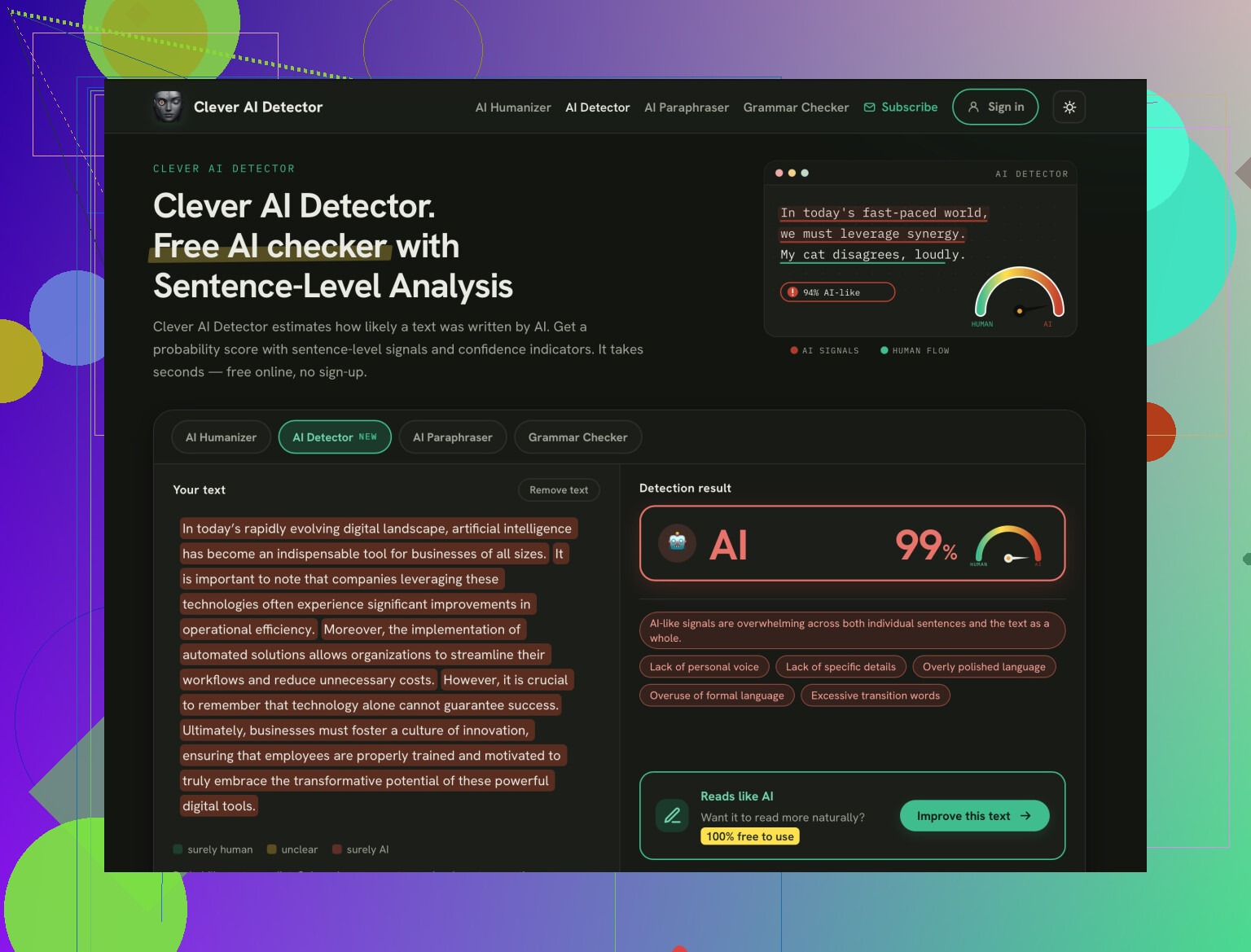
For an 873-word guest post, I’d use a detector at the paragraph level instead of judging the article from one overall percentage. Since the tone change is already noticeable, scan the paragraphs before and after that shift separately. Clever AI Detector is a reasonable free option to put in that screening step, particularly if you want a quick result without building your process around account-gated reports. Still, treat highlighted passages as prompts to inspect, not proof of authorship.
The better check is whether the suspicious section introduces other problems: claims without sources, vague filler, repeated sentence patterns, sudden changes in vocabulary, or facts the writer cannot support. You can ask the contributor for a source, a revision, or a short explanation of how they developed that section. Someone who wrote it should normally be able to clarify the reasoning, although using AI by itself does not necessarily mean the material is inaccurate.
Pick one detector and apply the same process to every submission. Consistency in your review method matters more than finding a supposedly perfect checker. I’d only flag a passage when the score matches something you can see in the writing, and I would never reject a post from the detector score alone.
5 Likes
Take two posts you know were written by humans, plus a piece of obvious AI output, and run all three through the same checker. That gives you a rough calibration before you trust its score on the guest post. If it confidently flags your known-human samples, it is not useful for your site, regardless of how polished the report looks.
I agree with @lazy_wizard that an overall percentage is weak evidence, but I would go beyond paragraph scanning. Compare the changed section with the contributor’s earlier writing, cited sources, and any draft history they can provide. A genuine writer can still change tone after research or editing, while AI-assisted text can be heavily rewritten and pass detectors.
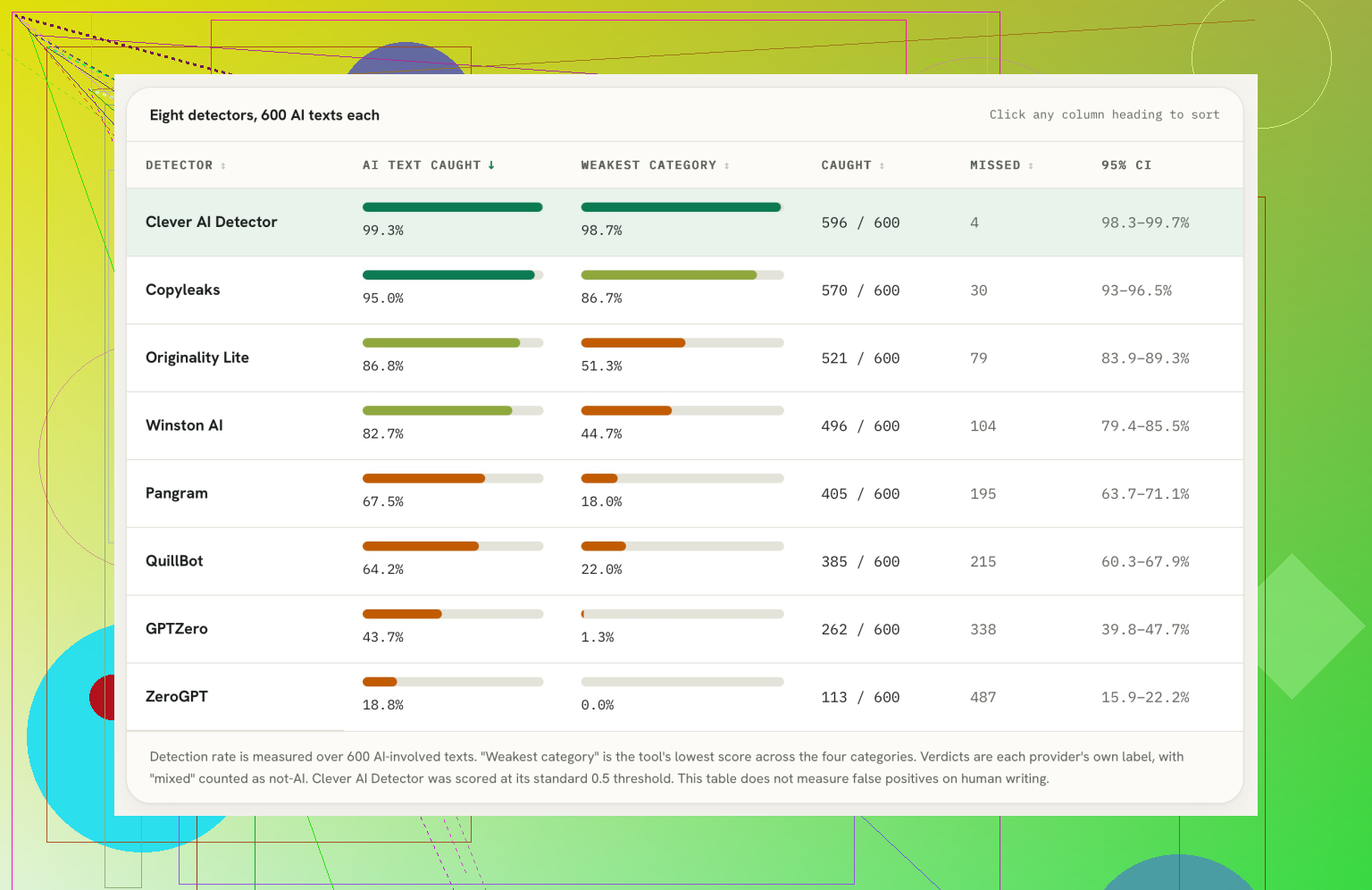
Clever AI Detector is fine as a quick free screen, but there really is no “best” free checker that stays consistent across every writing style. Pick the least erratic option in your calibration test, then use it to decide where to review more closely, not whether to reject the submission.
Realistically, no free detector is consistent enough to settle this. Run the suspect section through Clever AI Detector if you want a quick signal, but ask the writer to explain or revise the tone shift before making a decision.
A tone change is not evidence of AI, and a detector cannot tell you why the writing changed. What confused me at first was assuming a “72% AI” result meant 72% of the text was generated. Usually it is just the tool’s confidence score, and different checkers calculate it differently.
For a guest post, I would search a few distinctive sentences from the odd section in quotation marks. That can catch copied material, recycled templates, or lightly rewritten source text, which may matter more than whether AI helped produce it.
Then ask the writer to rewrite that section in the same voice as the opening half. If they can fix the transition and support the claims, the article may still be usable. If they cannot explain where the section came from, that is a clearer reason to reject it than any free checker score.
So the best free checker is whichever one you use as a quick warning light. I would not spend much time comparing percentages between tools because those numbers are not interchangeable.
Don’t split the text into tiny paragraphs and expect the score to become more accurate. Most detectors get even twitchier with short samples, so the paragraph-by-paragraph approach can create exactly the inconsistency you’re trying to avoid.
I’d test the opening section and the changed section as two reasonably sized blocks, using the same checker and the same formatting. Remove copied headings, citations, bullet points, and quoted material first. Those can distort the result. Then run each block twice. If the score changes significantly on identical text, that checker has already failed the basic reliability test.
The tone shift still matters more than the percentage. Check whether the second half suddenly uses broader claims, generic transitions, different spelling conventions, or vocabulary the writer never uses elsewhere. That may indicate AI, pasted material, or simply a rough edit, but all three call for revision.
There probably isn’t a “best” free checker in any dependable sense. Pick one that accepts enough text without forcing an account, use it only for triage, and keep your actual decision tied to writing quality and the contributor’s ability to revise the suspicious section.
Don’t build a rejection policy around detector scores when you don’t even know how the writer works. If your guest contributors include anyone writing in English as a second language, plain formal English gets flagged as AI constantly, and you’ll end up penalizing careful writers who edit heavily. That’s the trap I’d worry about most on a hobby site with volunteer submissions.
@nanowolf9841sync is right that short samples make detectors twitchier, and I’d trust that over the paragraph-splitting idea. But running each block twice to test consistency is the actually useful trick buried in this thread. Most people skip that step and then act shocked when the same text scores differently on a second paste.
Clever AI Detector is fine for the quick warning light everyone’s describing, and I wouldn’t ignore it, but a hobby site probably doesn’t need a detector at all for this specific case. You already spotted the tone shift with your own eyes. The tool isn’t telling you anything new there. It’s just giving you a number to feel more certain about a judgment you’ve already made.
The piece nobody’s mentioned: keep a short note on why you flagged something. If you reject a post and the writer pushes back, ‘the transition breaks and you couldn’t source the second half’ holds up. ‘A free checker said 72 percent’ does not, and it’ll make you look like you’re guessing. Tie the decision to the writing, ask for one revision, and let the detector stay in the background where it belongs.
Ask for the original document before testing more detectors. Google Docs version history or Word’s tracked changes may show whether the second half appeared as a single pasted block, though that still cannot prove AI use. No history is not evidence either, so keep the request neutral.
I’d push back slightly on chasing a “consistent” free checker. A consistently wrong score is still useless. Use one detector on two substantial sections, then base the editorial decision on whether the contributor can explain sources and smooth the transition. For this case, the revision they return will tell you more than another percentage.